Research note · October 5, 2026
Gender Gaps in Access to Startup Capital in Armenia
What the visible funding data tells us about women founders, and why investor networks and care responsibilities matter.
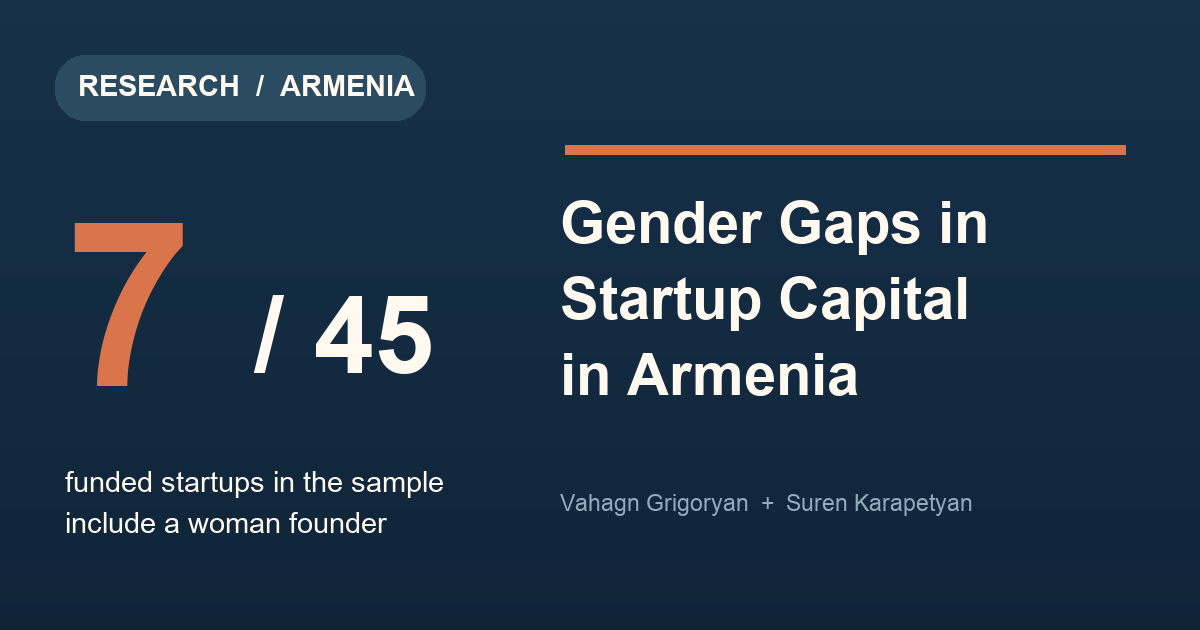
In our FREE Network policy brief, we examine who can reach early-stage investment in Armenia. Of 45 funded startups visible across eight venture capital firms and angel investor groups in the study sample, seven appear to include a woman founder or cofounder—about 15%.
This is an exploratory finding based on partial public data, not a measure of every Armenian startup or proof that any one factor caused the gap. It is a strong reason to ask where women founders encounter barriers along the path to capital.
Why access can differ
Startup investment often moves through introductions, repeated meetings, and trust built over time. In a small ecosystem with relatively few funding channels, those relationships can carry particular weight. Founders outside the most visible investor networks may have fewer chances to be seen and assessed.
Time also shapes access. Fundraising requires events, follow-up, travel, and flexibility. Research reviewed in the brief points to heavier care and work-life burdens for women entrepreneurs in Armenia. When investor access depends on evening networking or long periods of informal relationship-building, those constraints can compound.
The available funding data itself has limits. Without systematic information on founder gender, stage, ticket size, and outcomes across grants, accelerators, angel deals, and venture capital, it is difficult to know exactly where the gap widens or whether a program is improving access.
What a more inclusive funding market could do
- Measure the pipeline. Track who applies, receives introductions, raises capital, and secures follow-on funding, while protecting founders' privacy.
- Open more routes to investors. Use structured introductions, daytime and online sessions, and transparent selection criteria alongside informal networks.
- Make participation feasible. Consider flexible scheduling and childcare support as part of the conditions that allow founders to pursue capital.
These steps address different parts of the problem. The brief does not claim that any single intervention will close the funding gap on its own; it argues for better evidence and a more accessible path into investment.
Original research
This article is an original summary of Gender Gaps in Access to Startup Capital in Armenia, published by FREE Network on September 28, 2026. Read the full policy brief, methodology, and references.